
Introduction
Artificial Intelligence (AI) is no longer limited to laboratories, research centers, or high-tech industries. Today, AI has become a powerful force in the world of sports. From player performance analysis to injury prevention, from referee decision-making to fan engagement, AI is changing how sports are played, managed, and experienced. Sports organizations, coaches, athletes, and even fans are now using AI-driven technologies to gain insights, improve performance, and make better decisions.
What Is Artificial Intelligence in Sports?
Artificial Intelligence in sports refers to the use of machine learning, data analytics, computer vision, and predictive algorithms to analyze sports-related data and support decision-making. AI systems can process massive amounts of data much faster than humans and identify patterns that are impossible to detect manually.
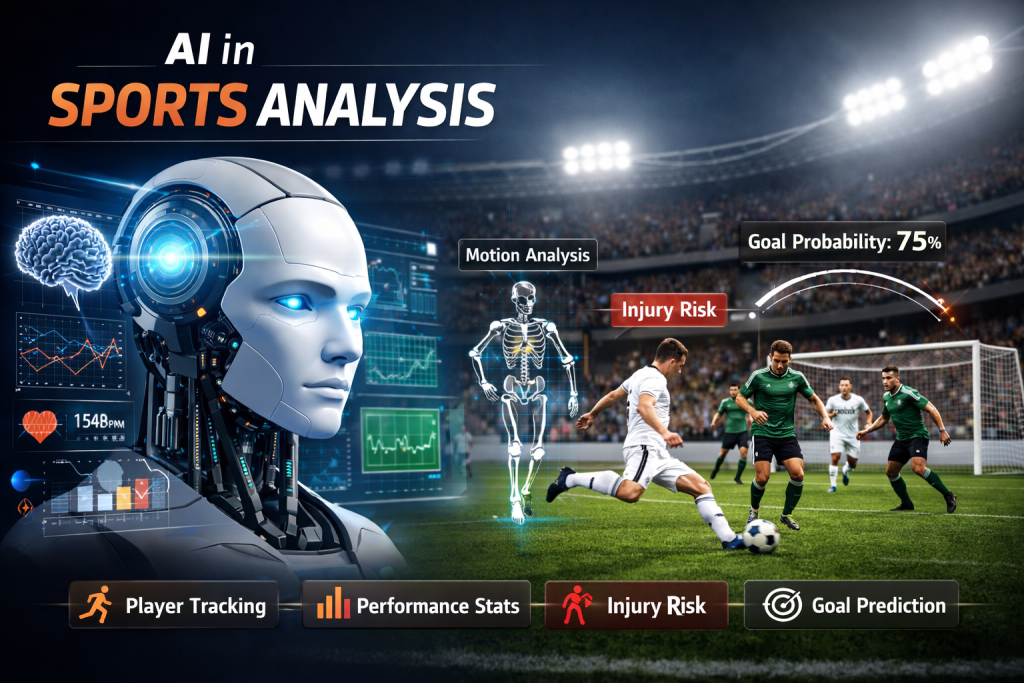
– Analyze player performance
– Predict injuries and fatigue
– Improve training methods
– Assist referees and officials
– Enhance fan experience
AI does not replace athletes or coaches. Instead, it acts as a powerful support system that helps them perform better.
—
How AI Collects Data in Sports
AI systems depend on data. In sports, data is collected from multiple sources such as wearable devices, smart cameras, GPS trackers, and sensors.
Wearable devices track heart rate, speed, distance covered, and body movement. Smart cameras record matches and training sessions. Sensors placed in equipment like balls, bats, or shoes collect real-time performance data. All this data is sent to AI systems, where it is analyzed to generate insights.
—
AI in Player Performance Analysis
One of the most important uses of AI in sports is player performance analysis. AI tools analyze match footage and training data to evaluate a player’s strengths and weaknesses.
Coaches can see how fast a player reacts, how accurate their movements are, and how consistent their performance is. AI can compare a player’s current performance with past data to identify improvement or decline. This helps coaches design personalized training programs for each athlete.
—
AI in Training and Coaching
AI has revolutionized sports training. Traditional coaching depends heavily on observation and experience. AI adds scientific precision to this process.
AI-based training systems provide real-time feedback to athletes. For example, in cricket or tennis, AI can analyze a player’s batting or serving technique and suggest corrections. In football and basketball, AI helps coaches plan strategies based on opponent behavior and historical match data.
This makes training more efficient and reduces trial-and-error methods.
—
AI in Injury Prevention and Recovery
Injuries are one of the biggest challenges in sports. AI plays a crucial role in predicting and preventing injuries.
By analyzing workload, muscle stress, movement patterns, and recovery time, AI systems can identify early signs of injury risk. Coaches can then reduce training intensity or change exercises to avoid serious injuries.
AI is also used during recovery. Personalized rehabilitation programs are designed based on data, ensuring faster and safer recovery for athletes.
—
AI in Refereeing and Decision Making
Human referees can make mistakes due to pressure, speed of the game, or limited viewing angles. AI helps improve fairness and accuracy in decision-making.
Technologies like goal-line technology, VAR (Video Assistant Referee), and ball-tracking systems use AI and computer vision. These systems analyze real-time footage to assist referees in making correct decisions.
AI does not replace referees but supports them by reducing human error.
—
AI in Strategy and Game Planning
Sports strategy has become more data-driven because of AI. Teams use AI to analyze opponent tactics, player behavior, and match patterns.
AI systems can simulate different game scenarios and predict possible outcomes. Coaches use this information to choose the best strategies before and during matches. This gives teams a competitive advantage.
—
AI in Fan Engagement and Experience
AI is not only for players and coaches. It also enhances the fan experience.
AI-powered recommendation systems suggest highlights, matches, and content based on fan preferences. Chatbots answer fan queries instantly. Virtual assistants provide live match statistics and analysis.
AI also helps create immersive experiences through virtual reality and augmented reality, making fans feel closer to the action.
—
AI in Sports Broadcasting and Media
AI has transformed sports broadcasting. Automated cameras track players and the ball without human operators. AI generates instant highlights and match summaries.
Broadcasters use AI to analyze viewer preferences and deliver personalized content. This improves viewer engagement and increases revenue for sports organizations.
—
AI in Talent Identification and Scouting
Finding new talent is expensive and time-consuming. AI makes talent identification more efficient.
AI analyzes performance data from young athletes across different regions and competitions. It identifies potential talent based on performance patterns rather than reputation or bias. This helps teams discover hidden talent and invest wisely.
—
AI in Sports Equipment and Technology
Sports equipment is also becoming smarter with AI integration. Smart shoes, rackets, bats, and balls collect performance data and provide feedback.
AI helps manufacturers design better equipment by analyzing how athletes use it. This improves safety, comfort, and performance.
—
AI in Esports and Virtual Sports
Esports is one of the fastest-growing industries, and AI plays a major role in it.
AI is used to analyze player strategies, balance game mechanics, and detect cheating. Virtual sports simulations also use AI to create realistic player behavior and match outcomes.
—
Benefits of AI in Sports
AI offers many advantages in sports:
– Improved performance analysis
– Reduced injury risk
– Fairer decision-making
– Better fan engagement
– Cost-effective talent scouting
AI makes sports more scientific, transparent, and competitive.
—
Challenges and Limitations of AI in Sports
Despite its benefits, AI in sports faces challenges.
Data privacy is a major concern, especially with wearable devices. High costs of AI systems limit access for smaller teams. Over-dependence on technology can reduce human creativity and intuition.
Ethical concerns also arise regarding data ownership and fairness.
—
Future of AI in Sports
The future of AI in sports is very promising. AI systems will become more accurate, affordable, and accessible.
In the future, AI may provide real-time strategy suggestions during matches. Fully automated training environments may become common. Fans will enjoy more immersive and personalized experiences.
AI will not replace human passion in sports but will enhance it.
—
Conclusion
Artificial Intelligence is transforming sports at every level. From training grounds to stadiums, from players to fans, AI is changing how sports are played and experienced. By improving performance, reducing injuries, and enhancing engagement, AI has become an essential part of modern sports.
As technology advances, the role of AI in sports will continue to grow, making sports smarter, safer, and more exciting for everyone.
Frequently Asked Questions (FAQ)
What is AI used for in sports?
AI is used for performance analysis, injury prevention, coaching, refereeing, strategy planning, and fan engagement.
Can AI replace coaches in sports?
No, AI supports coaches by providing data-driven insights but cannot replace human experience and leadership.
Is AI safe for athletes?
Yes, when used responsibly. However, data privacy and ethical use are important concerns.
Which sports use AI the most?
Football, cricket, basketball, tennis, and motorsports use AI extensively.
Is AI the future of sports?
Yes, AI will play a major role in the future of sports by improving efficiency, fairness, and fan experience.